


Keeladi Excavation Report: What Does the Archaeological Evidence Really Say?
Keeladi is unquestionably important to Tamil archaeology—but it is not the whole of Tamil history. What do carbon dates from Keeladi, Adichanallur and other sites actually establish? A scientific examination of the evidence behind the debate.

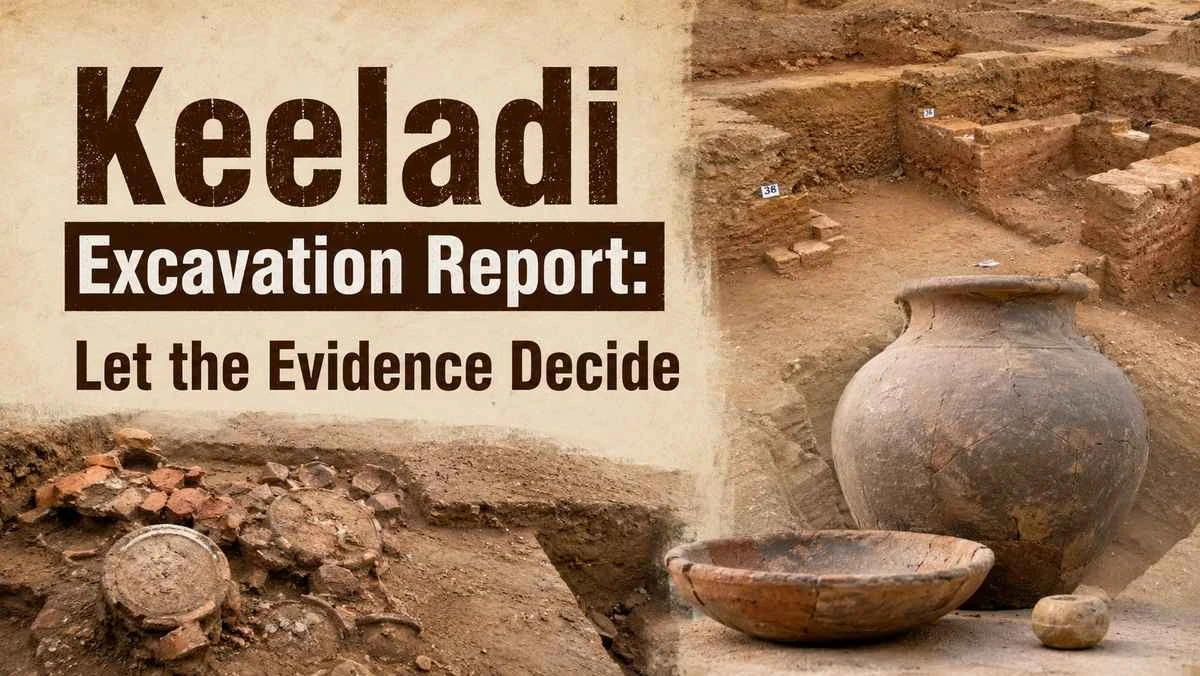
Tamil Oodagam Special Article
By Valarmeyyarivaan (a) Vishwaa Viswanaath
Keeladi has become one of the most discussed archaeological sites in Tamil Nadu over the past decade.
The archaeological significance of Keeladi is well established. Brick structures, ring wells, drainage features, industrial remains, beads, ivory objects, pottery and inscribed sherds unearthed at the site have contributed substantially to our understanding of the society that flourished in the Vaigai valley.
But recognising the importance of Keeladi is one thing. Accepting every chronological claim made about the site without scientific scrutiny is another.
The basic principle of archaeology is simple:
A historical claim should be only as strong as the evidence supporting it.
It is therefore necessary to separate the archaeological evidence from the political controversy that has increasingly surrounded the Keeladi excavation report.
What did the first excavations actually establish?
The first two phases of excavation at Keeladi were conducted by the Archaeological Survey of India under archaeologist K. Amarnath Ramakrishna.
Organic samples recovered during these excavations were subjected to Accelerator Mass Spectrometry — AMS Carbon-14 dating.
The early radiocarbon results broadly placed samples from these excavations in the centuries before the Common Era.
This is important because radiocarbon dating is frequently misunderstood in public debate.
A radiocarbon age expressed as BP — Before Present — cannot simply be converted into a precise BCE year by subtraction. In radiocarbon science, “Present” conventionally means 1950, but laboratory results need to be calibrated against internationally accepted calibration curves to obtain probable calendar-age ranges.
Therefore, describing the entire first two phases of Keeladi simply as “300 BCE” is an oversimplification.
At the same time, those early radiocarbon measurements by themselves did not automatically establish an eighth-century BCE date for the earliest occupation at the site.
That distinction is crucial to understanding the present controversy.
The Fourth Phase Changed the Chronological Picture
The Tamil Nadu State Department of Archaeology subsequently continued excavations at Keeladi.
Scientific analysis of carbon samples recovered during the State Department's excavations pushed the archaeological chronology of Keeladi further back.
The Tamil Nadu Department of Archaeology states that analysis of carbon samples from Keeladi produced a date of 580 BCE, placing the site in the sixth century BCE.
This was a major development.
It provided scientific evidence for activity at Keeladi significantly earlier than the dates popularly associated with the initial excavation results.
The importance of this evidence should neither be understated nor exaggerated.
It demonstrates precisely why archaeological chronologies must remain open to revision whenever new excavations and new scientific evidence become available.
Adichanallur Is Even More Important to the Chronological Debate
Keeladi is not the only archaeological site available to us when discussing the antiquity of Tamil society.
Adichanallur provides a striking example.
According to the Archaeological Survey of India's excavation report, organic material associated with the early cultural phase at Adichanallur produced a conventional mid-range date of 750 BCE and a calibrated mid-range date of approximately 850 BCE.
Another sample associated with the middle phase produced a calibrated mid-range date of approximately 650 BCE.
The ASI report notes that, taking the 95.4 per cent probability into account, these dates place the relevant cultural phases broadly between 850 BCE and 650 BCE.
This leads to an important conclusion:
The antiquity of Tamil civilisation does not stand or fall on Keeladi alone.
There are other archaeological sites in Tamil Nadu that have produced extremely early scientific dates.
One Carbon Date Does Not Date an Entire Civilisation
There is another scientific principle that must be understood.
Carbon-14 dating normally dates organic material — such as charcoal, seeds, grains or suitable biological remains.
It does not automatically provide the manufacturing date of every artefact found nearby.
Archaeologists must therefore ask:
+ From which stratigraphic layer was the sample recovered?
+ Was the archaeological context undisturbed?
+ What objects were associated with that sample?
+ Could material have moved between layers?
+ Do several independent samples produce consistent dates?
How does the radiocarbon evidence correspond with pottery typology, stratigraphy, inscriptions and other archaeological material?
Only after examining such questions can archaeologists construct a reliable chronology for a cultural phase.
Taking a single Carbon-14 number and presenting it as the birth date of an entire civilisation is not sound archaeology.
Why Did Amarnath Ramakrishna's Report Become Controversial?
This brings us to the heart of the present dispute.
Amarnath Ramakrishna submitted an extensive 982-page report on the Keeladi excavations to the Archaeological Survey of India.
The chronology proposed in the report reportedly included an earliest phase extending from approximately the eighth to fifth centuries BCE.
ASI subsequently questioned aspects of the report and sought revisions.
By December 2025, an internal five-member ASI committee had produced a 114-page evaluation describing parts of the report as “ambiguous, incomplete and underdeveloped.” Among other objections, the review questioned aspects of the interpretation of stratigraphy and material evidence.
Ramakrishna rejected demands that would alter his archaeological interpretation, maintaining that his chronology was reconstructed using stratigraphic sequence, cultural deposits, material culture and AMS dating.
The dispute therefore cannot responsibly be reduced to a slogan such as:
“The Union government is suppressing Tamil history.”
Nor can the issue simply be closed by declaring:
“Amarnath Ramakrishna's conclusions are wrong.”
Both positions require evidence.
Let the Full Report Be Published
There is, however, a legitimate question for the Union government and the Archaeological Survey of India.
If the chronology proposed by Amarnath Ramakrishna is scientifically unsustainable, the reasons should be demonstrated transparently.
+ What samples support the proposed eighth-century BCE phase?
+ From which stratigraphic layers were they recovered?
+ What are their laboratory identification numbers?
+ What are their conventional radiocarbon ages?
+ What are their calibrated probability ranges?
+ What is the archaeological association between the dated samples and the relevant cultural material?
+ On what scientific grounds did ASI reviewers challenge the proposed chronology?
These are questions that can be answered with data.
The solution, therefore, should be greater transparency — not less.
Publish the excavation report and make the underlying scientific evidence available for scholarly scrutiny.
As of June 2026, the dispute had still not been finally resolved: the ASI Director-General informed Tamil Nadu MP D. Ravikumar that an internal committee would “re-examine the report on site.”
That itself demonstrates why the debate should remain scientific rather than partisan.
The Same Standard Must Apply to Political Claims
Political leaders and public figures have repeatedly criticised the delay in publication of the Keeladi report and alleged that Tamil history is being suppressed.
They are entitled to raise those questions.
But archaeology requires another question to be asked with equal seriousness:
What direct scientific evidence securely establishes the eighth-century BCE chronology proposed for the earliest phase of Keeladi?
Asking this question is not an attempt to diminish Tamil antiquity.
Quite the opposite.
If Tamil antiquity is to be established convincingly before the international academic community, its strongest foundation must be verifiable scientific evidence.
Tamil Antiquity Is Bigger Than Keeladi
Perhaps the greatest mistake in the public debate is the impression that the antiquity of Tamil civilisation depends entirely on one excavation report.
It does not.
Keeladi is important.
But so are Adichanallur, Sivagalai, Kodumanal, Mayiladumparai and numerous other archaeological sites across Tamil Nadu.
New scientific studies relating to the Iron Age in Tamil Nadu have opened even larger questions about the chronology of technological and cultural developments in South India.
Tamil archaeology is therefore much bigger than Keeladi.
And Tamil antiquity does not need to depend upon a single archaeologist, a single excavation, a single government or a single political argument.
Archaeology Must Not Be Made to Follow Politics
If scientifically established evidence places an archaeological context at 300 BCE, it should be accepted as 300 BCE.
If another securely dated context produces 580 BCE, that evidence should be accepted.
If evidence from Adichanallur supports dates around 850 BCE, those results must also be acknowledged.
And if future excavations and multiple independent scientific tests establish dates of 1000 BCE, 2000
BCE or earlier, archaeology must be prepared to accept those dates as well.
That is how science works.
History cannot be made older because we want it to be older.
Equally,
History cannot be made younger because someone is uncomfortable with its antiquity.
Evidence must decide.
Make the Data Public
There is a straightforward way to end much of the Keeladi controversy.
The Archaeological Survey of India should make the complete excavation report available for
scholarly examination, subject to normal archaeological publication procedures.
The scientific documentation relevant to the disputed chronology — radiocarbon results, stratigraphic records, trench documentation, pottery sequences, material analyses and other primary archaeological data — should be available for scrutiny.
The objections raised by reviewers should also be presented transparently.
Then archaeologists and specialists can examine the evidence.
Does the evidence sustain an eighth-century BCE chronology?
Is the sixth century BCE currently the more securely established horizon?
Could additional evidence modify the chronology again?
Politicians should not decide these questions. Evidence should.
Keeladi is unquestionably an important archaeological site in the history of Tamil Nadu.
But Keeladi is not the whole of Tamil history.
Tamil antiquity no longer needs to rest on political slogans or on the authority of any single individual.
From Adichanallur to Keeladi and other archaeological landscapes across Tamil Nadu, there is a growing body of material and scientific evidence waiting to be studied.
The Union government should not unnecessarily delay scholarly publication.
Amarnath Ramakrishna's chronology, like every archaeological interpretation, must remain open to scientific scrutiny.
Political parties, too, should resist turning archaeological dates into partisan slogans.
Tamil history does not need political protection.
It needs open data, transparent research, continuing excavation and scientific integrity.
Because the strongest instrument for establishing the antiquity of Tamil civilisation is not emotion.
It is evidence.
What's Your Reaction?
 Like
0
Like
0
 Dislike
0
Dislike
0
 Love
0
Love
0
 Funny
0
Funny
0
 Wow
0
Wow
0
 Sad
0
Sad
0
 Angry
0
Angry
0














Comments (0)