


Onam Before Modern Kerala: Tamil Inscriptions, Sangam Literature and the Forgotten History of Thiruvonam
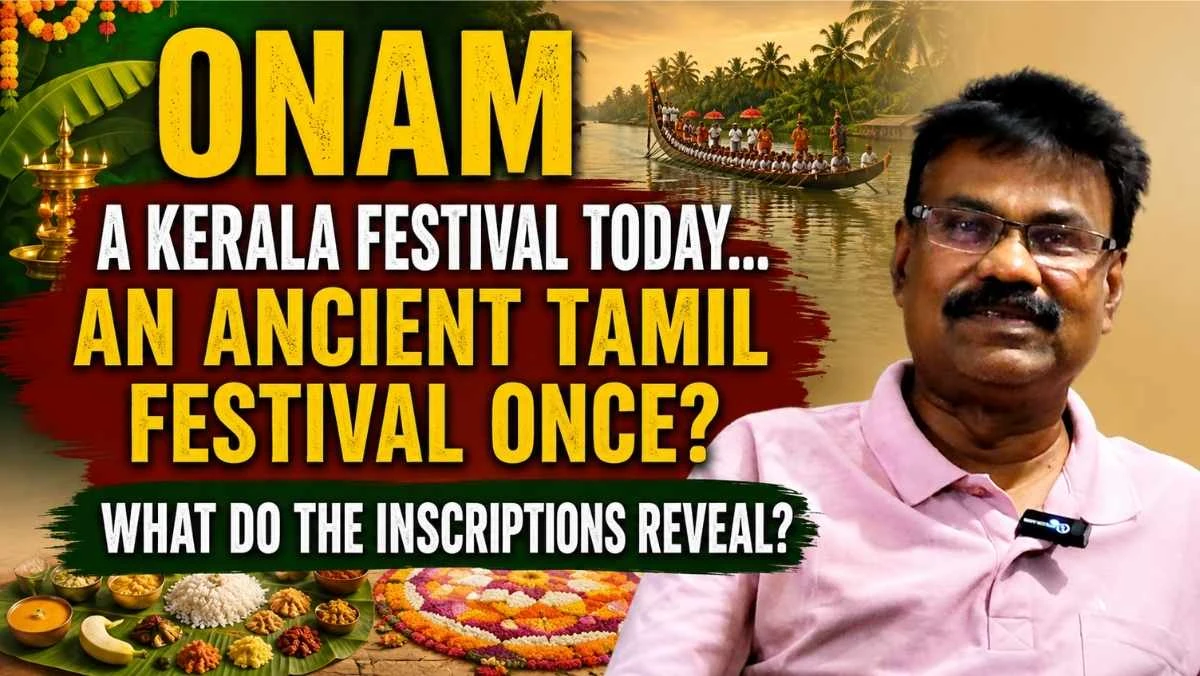
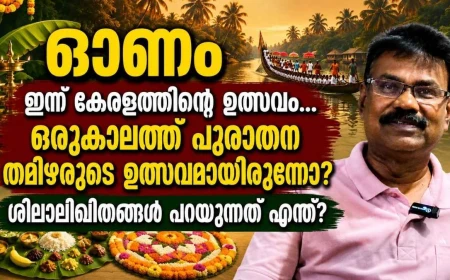
Was Onam celebrated by ancient Tamils? Archaeologist Narayanamoorthy examines Sangam literature, the Thiruvalla copper plates and Chola inscriptions to trace the historical evolution of Thiruvonam.

Tamil Oodagam Special Feature
Today, Onam is celebrated as the great harvest and cultural festival of Kerala. Pookalams bloom at doorsteps, families gather for the Onasadya, and the legendary return of King Mahabali — Maveli — forms the emotional heart of the celebration.
But was Onam always confined to present-day Kerala?
Archaeologist Narayanamoorthy argues that the historical trail leads much further back — into the ancient Tamil country and the Sangam age.
According to him, Onam was once celebrated by ancient Tamils and subsequently survived in different forms through the Chera and Chola periods.
Literature provides one part of that story.
Copper plates and stone inscriptions provide another.
Together, he argues, they reveal a fascinating transformation: from an ancient festival of the people to a temple-centred religious observance, and eventually to a festival that disappeared from much of present-day Tamil Nadu while surviving and flourishing in the old Chera country — modern Kerala.
Onam in Ancient Tamil Literature
The connection does not begin with medieval inscriptions.
Narayanamoorthy points to references to Thiruvonam in Tamil literary traditions, including Maduraikkanchi of the Sangam corpus Pathupattu, and later works associated with the Bhakti period such as the Thevaram and Nalayira Divya Prabandham.
His interpretation connects the festival's earlier cultural background with the Mullai landscape of ancient Tamil society — the landscape associated with Mayon in Tholkappiyam.
In this reading, Onam was originally a festival of ordinary people and was connected with the agricultural cycle and newly harvested rice.
The character of the celebration, however, changed over time.
A 9th-Century Copper Plate Records Onam
One of the most interesting pieces of evidence discussed by Narayanamoorthy comes from the Thiruvalla copper plates.
The plates were issued during the 17th regnal year of Chera ruler Ko Thaanuravi, around AD 869, and belonged to the temple at Thiruvalla in present-day Pathanamthitta district of Kerala.
Narayanamoorthy describes the inscription as being in Tamil and written in Vatteluttu script, while noting that Malayalam archaeologists classify its language as Old Malayalam.
What makes the record particularly significant is the detail with which an Onam feast is described.
The inscription refers to arrangements by the Thiruvattuvay Sabha and the Adikal for conducting an Onam feeding according to established local custom.
Land donated by Senthan Sankaran, together with other specified resources, was to support the observance.
The record also mentions an Onam food distribution or “Onachoruttu.”
And this was not a casual arrangement.
According to the inscription as presented by Narayanamoorthy, anyone obstructing the arrangement was liable to a penalty of 54 kaanam of gold.
Rice, Ghee, Jaggery, Bananas — An Elaborate Onam Feast
The copper plate goes into remarkable detail about food.
If the prescribed obligations were not carried out, provisions including ghee, pulses, jaggery, bananas and oil were to be supplied.
Food was to be served from the time the morning shadow reached a specified length until evening.
On Onam morning, 200 nazhi of rice from 25 para of rice was to be offered.
A further 200 nazhi was to be presented to Thiruvallavazhappan as another offering.
The record additionally states that Krishnan Devan–Vilakkili Mangalam was required to provide another 50 nazhi of rice to Thiruvallavazhappan on Onam day.
That rice was to come from the Kattoor grove, and even the measuring vessel was specified: the nazhi maintained in the temple kitchen, or madappalli.
These details demonstrate that by the ninth century, Onam had acquired an organised institutional and temple-linked form in the Chera country.
But the evidence is not confined to Kerala.
Onam in Tamil Nadu's Stone Inscriptions
Tamil inscriptions from places such as Tiruchengode, Keezhapazhuvur and Tiruvellarai also preserve references to Thiruvonam-related observances.
Tiruchengode: Feeding 20 Brahmins
An 11-line inscription from Tiruchengode, assigned to the ninth regnal year of Chola ruler Kopparakesari, records that a woman named Manikandi Odaiyamantha of Erode deposited 20 kalanju of gold with the Thiruvonakanapperumakkal.
The purpose was to provide food for 20 Brahmins every month.
Another inscription on Tiruchengode hill, belonging to the 28th regnal year of Kongu Chola Kopparakesari, records that interest from deposited refined gold was to provide two kalams of rice for feeding two persons on Thiruvonam day.
These records are important because they place Thiruvonam observances firmly within the inscriptional landscape of present-day Tamil Nadu.
Keezhapazhuvur: Aval, Coconuts and Jaggery
Another record comes from Keezhapazhuvur in Udayarpalayam.
The 19-line inscription, attributed to the 16th regnal year of Chola king Kopparakesari, records an offering made by Marapiran Nambi, identified as the king's Srikaarya or secretary.
On the day of Onam, an offering was made to Ganapati of Thiruvalanthurai.
It consisted of:
one thooni of aval-amuthu, 10 coconuts and 10 palam of jaggery.
Once again, Onam appears not simply as a distant Kerala festival, but within a Tamil
temple inscription.
Tiruvellarai Records Thiruvonam
At Tiruvellarai, an inscription from the 15th regnal year of Kopparakesari records the provision of ghee for the sacred food offering — Thiruvamuthu — to the deity of the Periya Koyil.
The occasion?
Thiruvonam day in the Tamil month of Chithirai.
Taken together, Narayanamoorthy argues, these inscriptions demonstrate that Thiruvonam observances existed across areas now forming part of Tamil Nadu during the dynastic period.
So Was Onam Originally a Tamil Festival?
This is where the archaeological evidence and historical interpretation need to be distinguished carefully.
The inscriptions establish the presence of Thiruvonam-related observances, offerings and feeding practices in historical Tamil regions.
Narayanamoorthy goes further.
He argues that the dynastic-period observances were descendants of an older festival celebrated during the Sangam period and connected with the people of the Mullai landscape — the Mayon-meya landscape described in Tholkappiyam.
According to this interpretation, what began as a festival of ordinary people gradually underwent a religious transformation.
With the growth of the Bhakti traditions, it became increasingly associated with Vaishnavism, temple offerings and ritual feeding.
The Vamana incarnation narrative was subsequently attached to the festival.
In Tamil Nadu, Narayanamoorthy argues, the festival eventually declined and disappeared in this form.
In the old Chera country, however, it survived and evolved.
From Puthunel to Onam?
Narayanamoorthy links the older harvest character of the festival to the offering of newly harvested rice — punnel in Malayalam and puthunel in Tamil.
In this interpretation, Onam began as a people's harvest celebration before becoming increasingly integrated into religious ritual.
The transformation eventually connected the festival with Vamana, the fifth incarnation of Vishnu, and Mahabali or Maveli.
The geographical centre of this tradition is associated with Thrikkakara (Thirukalkkara) in the Kochi–Ernakulam region of Kerala.
And here the story acquires another layer.
Mahabali, Vamana and a Historical Debate
Popular Onam tradition remembers Maveli or Mahabali as a beloved ruler whose reign represented prosperity and equality.
The later religious narrative associates his fate with Vishnu's Vamana incarnation and his annual return to visit his people.
Narayanamoorthy places this tradition within a larger historical debate.
He notes that some archaeologists and historians have interpreted the Mahabali–Vamana narrative
through the framework of an old Aryan–Dravidian conflict, seeing Mahabali as a native ruler and Vamana as representing Brahmanical intervention.
In that interpretation, the defeat of an Asura king belonging to the Sudra varna is read symbolically as a conflict involving political power, social hierarchy and religious transformation.
This, however, is an interpretive historical framework rather than something demonstrated directly by the copper plates and inscriptions themselves.
The inscriptional evidence establishes Onam/Thiruvonam observances; interpretations of the Mahabali–Vamana story belong to a different layer of historical debate.
That distinction is important.
Yet Maveli Still Comes Home
Whatever the historical evolution of the legend, its cultural power remains extraordinary.
For the people of Kerala, Maveli is not merely a figure from an old religious narrative.
He is the king who returns.
Beginning ten days before Onam, homes welcome the season with colourful Pookalams.
The floral carpet becomes part celebration, part memory and part expectation.
The old Chera country waits symbolically for its beloved ruler.
And behind today's spectacular celebration lies a much longer historical trail — through harvest traditions, ancient Tamil literature, Chera copper plates, Chola inscriptions, temples, religious transformation and centuries of cultural memory.
That is why Onam deserves to be studied not simply as a modern festival belonging to one linguistic community, but as part of the interconnected cultural history of ancient Tamilakam and the Chera country.
As archaeologist Narayanamoorthy's reading reminds us, political borders and modern linguistic identities are much younger than many of South India's festivals.
Today Onam is inseparable from Kerala and Malayalam cultural identity. But the Tamil literary and inscriptional records cited here preserve an older historical dimension of Thiruvonam — one that reaches across the ancient Tamil and Chera worlds.
What's Your Reaction?
 Like
1
Like
1
 Dislike
0
Dislike
0
 Love
1
Love
1
 Funny
0
Funny
0
 Wow
0
Wow
0
 Sad
0
Sad
0
 Angry
0
Angry
0










Comments (0)