


Chennai Airport PPP Plan: AAI Moves, Fuel Tax Cut and Cochin Model
Chennai Airport's PPP plan gains momentum amid the CM's letter, AAI initiatives and aviation fuel tax cuts. Could Cochin Airport's model guide Chennai?

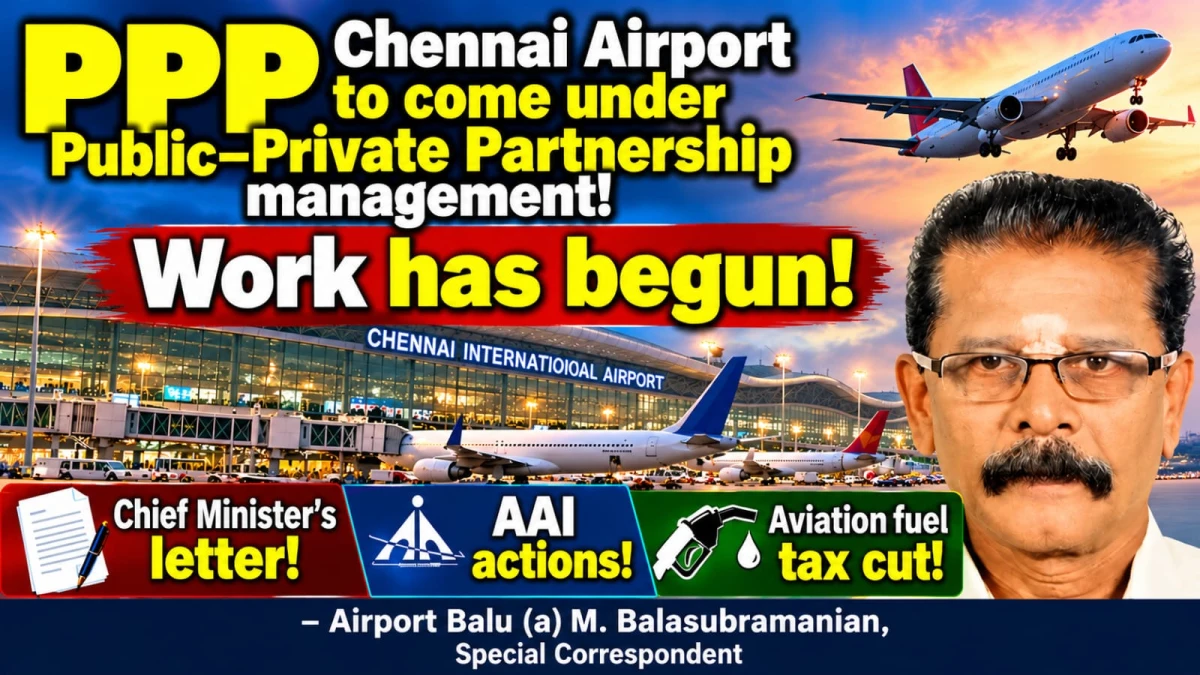
Chennai International Airport Set to Come Under Public–Private Partnership (PPP) Management; Preparatory Work Begins!
Chief Minister’s Letter, AAI Chairman’s Inspection of Chennai Airport, and Aviation Fuel Tax Reduction – A Series of Significant Developments!
– Airport Balu (a) M. Balasubramanian, Special Correspondent
Preparatory activities aimed at bringing Chennai International Airport under the Public–Private Partnership (PPP) model of airport management have begun gathering momentum.
The letter written by Tamil Nadu Chief Minister C. Joseph Vijay to Prime Minister Narendra Modi, the administrative initiatives undertaken by the Airports Authority of India (AAI), and the Tamil Nadu Government's reduction of aviation fuel taxes have heightened expectations regarding a possible change in the future management of Chennai International Airport.
Chief Minister’s Letter!
On August 5, Chief Minister C. Joseph Vijay wrote to Prime Minister Narendra Modi, urging the Union Government to make a time-bound decision regarding the transfer of Chennai Airport's operations, management, and future development to a new management entity.
The primary objective of this request was to ensure that Chennai Airport is developed in line with Tamil Nadu's growing industrial investments, international business activities, and increasing passenger and cargo transportation requirements.
Union Government Moves Towards the PPP Model!
According to information released on October 20, the Union Government is considering including Chennai and Kolkata airports in the next phase of its Public–Private Partnership programme.
Fourteen major airports, including those in Delhi, Mumbai, Bengaluru, and Hyderabad, are already operating with the involvement of private companies in airport management.
However, Chennai International Airport continues to remain under the direct administration of the Airports Authority of India (AAI).
The possibility of changing this arrangement is now being actively discussed.
AAI's Administrative Initiatives!
The change in leadership at the Airports Authority of India and developments concerning the new Chairman's inspection of Chennai Airport have also gained significance in this context.
The new Chairman, Shri Puneet Kansal, visited Chennai International Airport and held discussions with airport officials. The purpose of this inspection and the subsequent administrative steps are now attracting considerable attention.
Meanwhile, the Airports Authority of India has initiated the process of selecting a consultant to prepare a model agreement for airport projects under the PPP framework.
This represents an important preparatory step for PPP initiatives involving airports across the country.
Aviation Fuel Tax Reduced from 29% to 16%!
Against this backdrop, the Tamil Nadu Government issued a significant announcement on October 23.
The Value Added Tax (VAT) on Aviation Turbine Fuel (ATF) used for scheduled airline operations at Chennai Airport has been reduced from 29% to 16%.
At other airports across Tamil Nadu, excluding Chennai, the tax has been reduced from 29% to just 1%.
The revised tax rates will remain in effect from November 1, 2026, to October 31, 2027.
This reduction is expected to lower the operating costs of airlines, encourage the introduction of additional flight services, and potentially lead to lower airfares for passengers.
Are These Three Developments Directed Towards a Common Goal?
The Chief Minister's letter, the PPP-related preparatory measures being undertaken by the Airports Authority of India, and the Tamil Nadu Government's reduction of aviation fuel taxes cannot be viewed merely as isolated developments.
All three are connected to broader objectives, including improving the competitiveness of Chennai International Airport, attracting international investment, and expanding passenger and cargo transportation services.
What Happens Next?
If the Union Government takes a final decision to bring Chennai International Airport under the PPP model, several important issues will come into focus.
These include the terms and conditions of the project, the duration of the agreement, the selection of a private operating company, proposed investments, and the protection of airport employees' rights.
The implications for airport ownership, management responsibilities, and passenger charges will also become clearer at that stage.
Whether the initiatives currently being undertaken by the Tamil Nadu and Union Governments will mark the beginning of a new chapter in the administrative history of Chennai International Airport is a question that may be answered in the near future.
PPP Does Not Mean Complete Privatisation!
PPP is not a model of complete privatisation. Public–Private Partnership refers to a management arrangement involving cooperation between the government and private-sector entities.
The credit for transforming Cochin International Airport into one of India's finest airports through a similar government–private partnership model goes to a Tamilian named Ramalingam.
It was during his tenure as Chairman of the Airports Authority of India that this project was implemented in Cochin.
Furthermore, Cochin International Airport has earned the distinction of being India's first airport to operate entirely on solar power.
International flights also operate to and from Cochin International Airport.
Officials believe that Chennai International Airport could similarly witness significant improvements in its commercial activities, operational standards, and overall quality of services.
Let us wait and see. If these developments bring positive results, it will certainly be a matter of happiness.
What's Your Reaction?
 Like
0
 Dislike
0
 Love
0
 Funny
0
 Wow
0
 Sad
0
 Angry
0











Comments (0)