


Brahmi Is a Misnomer; "Thamizhi (Tamili) – Vada Thamizhi" Is Correct, Says Linguist and Archaeologist Narayanamoorthy
Linguist and Archaeologist Narayanamoorthy argues that the term "Brahmi" is linguistically incorrect for ancient Tamil inscriptions. He contends that the proper names are "Thamizhi" (Tamili) and "Vada Thamizhi," presenting historical, linguistic, and script-based arguments explaining the distinction between language and writing systems.

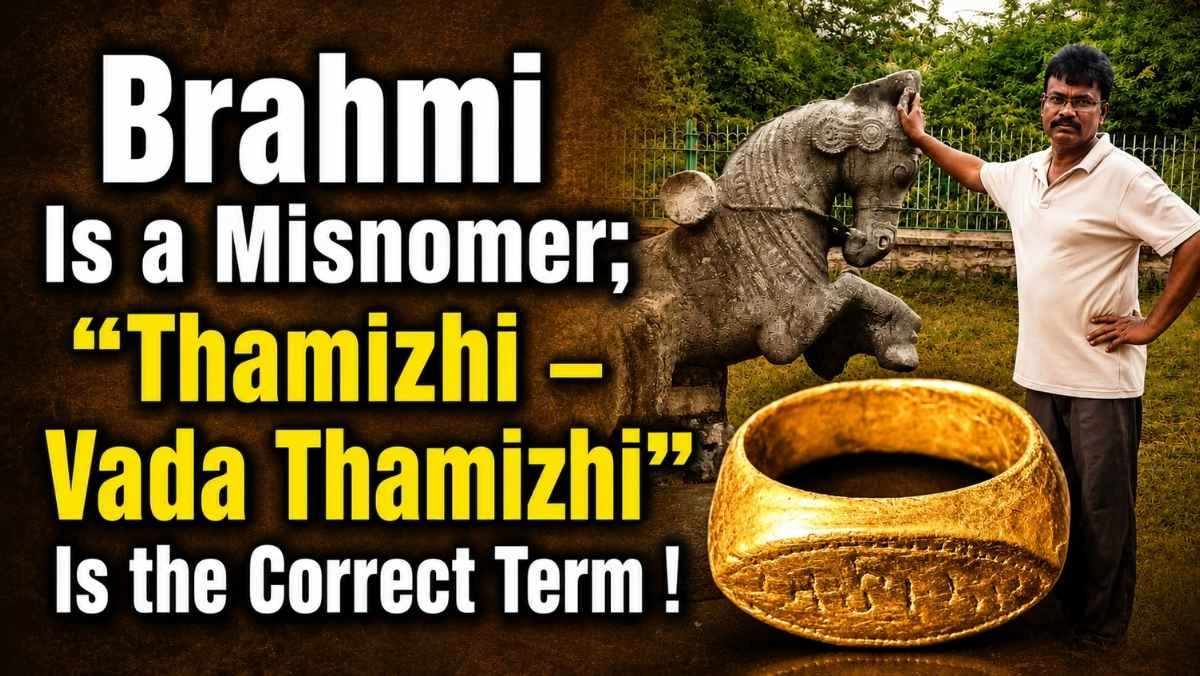
A detailed explanatory article by Linguist and Archaeologist Narayanamoorthy, arguing that the correct terms are "Thamizhi (Tamili) – Vada Thamizhi" rather than "Brahmi."
For inscriptions dating back approximately 2,000–3,000 years, several researchers and media outlets continue to refer to them as "Brahmi inscriptions" or "Tamil-Brahmi inscriptions."
However, Linguist and Archaeologist Narayanamoorthy firmly states that this is incorrect and that "Tamizhi" is the proper term.
Let us first understand the basic reasons behind this argument.
What is a Language?
A language is a system of communication used by human beings to exchange their thoughts, emotions, knowledge, experiences, and ideas.
Languages function in two major forms:
- Spoken Language – expressing ideas through sounds.
- Written Language – recording ideas through letters or scripts.
Many languages around the world existed only as spoken languages for thousands of years before they eventually acquired a written form.
What is a Script?
A script is the writing system used to represent the sounds of a language in written form.
In other words:
- Language consists of sounds.
- Script is the method used to write those sounds.
For example:
Tamil is a language. The ancient Tamils independently created and used their own writing system to represent it. This writing system is the Tamil script. Over time, it evolved through different stages into the forms known as Tamizhi, Vattezhuthu, and Tamizham, eventually developing into the modern Tamil script.
The Difference Between Language and Script
Language – the system of spoken sounds.
Script – the writing system used to represent those sounds.
Language can be heard.
Script can be seen and written.
A Simple Example
Tamil is a language.
The word "Tamil" can be written as:
- In Tamil script – தமிழ்
- In Roman script – Tamil
- In Devanagari script – तमिऴ् (approximate representation)
Thus, the language remains the same; only the script changes.
Examples from World Languages
- English uses the Roman (Latin) script.
- Hindi uses the Devanagari script.
- Urdu uses the Perso-Arabic script.
- Punjabi is written in two different scripts: Gurmukhi in India and Shahmukhi in Pakistan.
This clearly demonstrates that a single language may be written in more than one script. However, according to the author, Tamil has only its own indigenous script, and the Tamil writing system was not borrowed from anywhere else.
Language = the sound system through which humans communicate.
Script = the writing system used to record that language.
Language and script are distinct.
One language may be written in multiple scripts, and a single script may also be used to write more than one language.
The Reference to "Bumbhi"
According to the author, the Samavayanga Sutra, a Jain text composed during the 3rd century BCE, refers to the scripts used for the languages spoken across the Indian subcontinent at that time. The text, he says, mentions a script called "Bumbhi"
According to Narayanamoorthy, this "Bumbhi" was later Sanskritized into the forms Brahmi, Brahmi (alternate transliterations), and Brahmi (Prami).
Oral Tradition of Sanskrit
The Vedas, epics, and Puranas of the northern language (Sanskrit), according to the author, were transmitted orally through generations.
For this reason, they are known as:
- Shruti – "that which was heard."
- Smriti – "that which was remembered or recited."
The Author's Argument
According to Narayanamoorthy, when certain groups belonging to the Indo-Iranian / Indo-Aryan branch of the Caucasian race entered northern India after the final phase of the Indus Valley Civilization, their spoken languages did not yet possess a writing system.
Consequently, they were unable to document the oral traditions handed down by their ancestors in written form.
He argues that, since the Tamil script (Tamili) was then already in use throughout the Indian subcontinent, they adapted it to suit their own languages by introducing certain pronunciation changes, omitting some letters, and adding others.
According to him, the writing system thus adapted from the Tamil script came to be known as Bumbhi, which was later forcibly renamed Brahmi.
He further argues that this adapted writing system lacked certain distinctive Tamil letters such as ன, ழ, ற, ள, omitted the vowels எ and ஒ, and introduced four additional hard consonants suited to their language. A new graphic form was then created specifically for these added letters.
According to Narayanamoorthy, this writing system is what later came to be called
Brahmi.
However, he maintains that these are fundamentally Thamizhi (Tamili) characters, and therefore they should properly be referred to as "Vada Tamizhi" (Northern Thamizhi) rather than "Brahmi" or "Ashokan Brahmi."
He concludes that referring to them as Brahmi or Ashokan Brahmi is, in his view, linguistically incorrect.
What's Your Reaction?
 Like
3
Like
3
 Dislike
0
Dislike
0
 Love
0
Love
0
 Funny
0
Funny
0
 Wow
0
Wow
0
 Sad
0
Sad
0
 Angry
0
Angry
0













Comments (0)