


Thai Gold Ring Inscription: Tamil Name or Thai Identity? Archaeologist Narayanamoorthy’s New Study
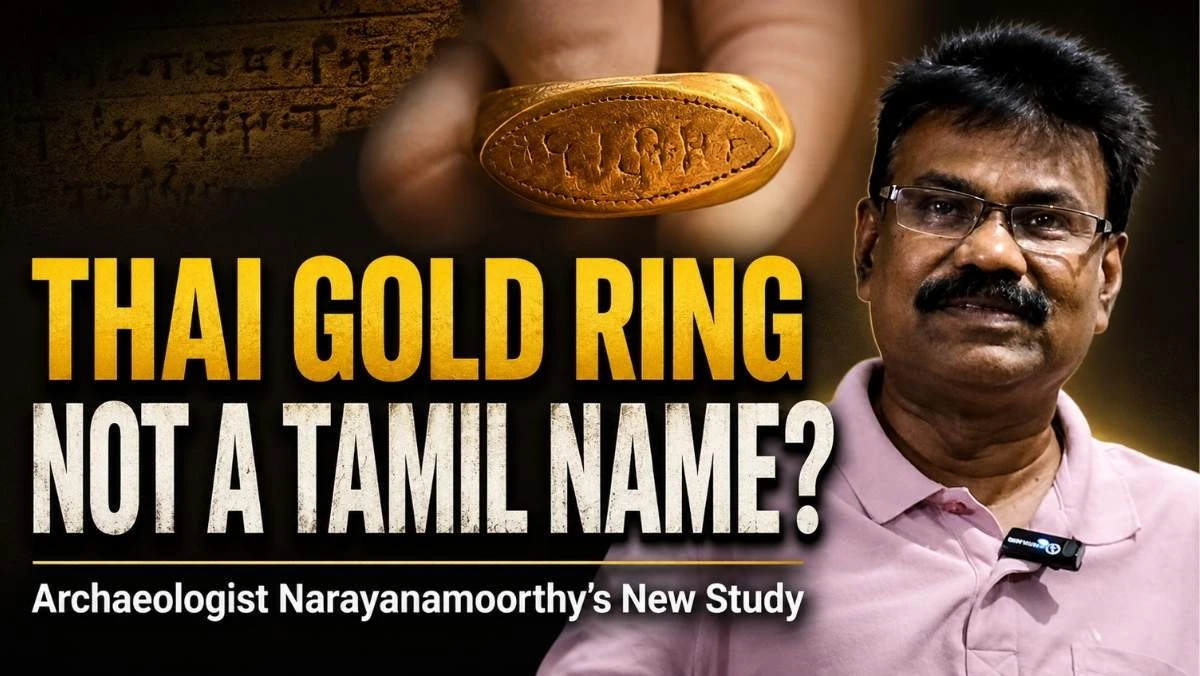
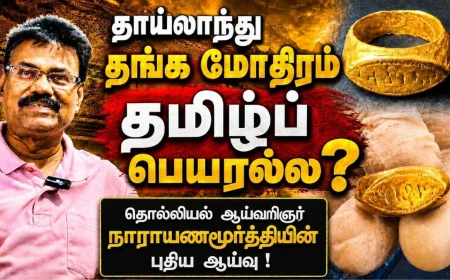
Does the 2,000-year-old gold signet ring discovered in Thailand contain a Tamil personal name? Archaeologist and linguistics researcher Narayanamoorthy compares the proposed readings, examines the Tamili and Northern Tamili letter forms, and argues that the inscription may belong to a Thai individual connected with the Theravada Buddhist tradition.

- A New Study by Archaeologist Narayanamoorthy
Is the "Tamili" (Brahmi) inscription found on a 2,000-year-old gold signet ring discovered in Thailand a Tamil personal name, or a word belonging to another language?
Archaeology and linguistics researcher Narayanamoorthy presents a detailed study comparing the different proposed readings.
The Gold Signet Ring Discovered in a Thai Excavation
We are aware that one of the two rings recently discovered during an archaeological excavation in Thailand created worldwide interest because it contained an inscription in the "Tamili script", which is generally called “Brahmi” in Sanskrit-oriented terminology. The other ring discovered at the same site had no inscription.
The Tamili Inscription That Attracted Global Attention
The inscription was generally announced as an example of an “ancient Indian script.” Epigraphists who examined it described the inscription on the signet ring as having been written in the mirror-reading method.
This is similar to the way the word “AMBULANCE” is written in reverse on modern ambulances. The writing can be read directly and understood only when viewed in a mirror. Like a modern rubber stamp, such signet rings were used in ancient times to imprint and transmit the owner’s approval or authentication.
The North Indian Scholars’ Reading: “Pusarakṣēthara”
North Indian epigraphists who studied the inscription announced that it was written in the Northern Tamili, or Brahmi, script and read it as:
“Pusarakṣēthara (ṭa)”
They interpreted “Pusa” as referring to the Pushya or Poosam star, and “rakṣēthara” as meaning “one who is protected.” They therefore explained the name as meaning “one protected by the Poosam star.”
The Interpretation Connecting the Name with Murugan
Some Tamil researchers influenced by Sanskrit-oriented interpretations suggested that the Poosam star belonged to Karthikeya, or Murugan, and therefore interpreted the expression as meaning “one protected by Murugan.”
The Reading of “Aḷarvairathan” as a Tamil Name
A software professional living in Thailand, who was familiar with the ancient Tamili script, was among the first to read the inscription after the signet ring was discovered.
He announced that the inscription was not in a northern language, but was a Tamil personal name written in pure Tamil as:
“Aḷarvairathan”
Reports also stated that epigraphists such as Marxia Gandhi and Santhalingam had accepted this reading.
What Is Actually Written on the Ring?
It is a gold ring—a signet ring. The letters on it appear to have been scratched into the metal after the ring had been made.
Engraving letters into metal in this manner is difficult. While scratching the metal, it is possible for the complete form of a letter not to appear, leaving gaps in different places. Since deep engraving could also damage the gold, it would have been natural for the engraver to avoid applying excessive pressure.
The inscription on this ring appears to have been made using such a scratched-engraving technique.
Comparison with the Tamili Letters on the Thenur Gold Bars
In 2013, Government Museum curator Periyasamy and I read the Tamili inscription found on the Thenur gold bars.These gold bars had been discovered as treasure in 2009 and were being preserved in the Madurai Government Treasury.
The inscription on them was read as:
“Pōkul Kuṉṟak Kōthai”
The letters on the Thenur gold bars had not been engraved using the scratching method seen on the Thai ring. Instead, they had been formed using a series of dots, somewhat like the machine engraving found on modern utensils. It was therefore easier for us to read them.
However, the letters visible in the presently published photograph of the Thai ring are unclear and the scratched lines are incomplete. This creates confusion for many who attempt to read them. That is why both North Indian and Tamil scholars have encountered difficulty.
Returning to the Thai Signet-Ring Inscription
When the letters on the ring are read directly from left to right, they can be read in both Tamil and a northern language approximately as:
“Ra(ṭa)-thaḷāraḷari”
However, this reading produces no meaningful expression in either language. We must therefore abandon the direct-reading method and turn to the mirror-reading method.
Evidence from the Tamili Inscriptions at Kundrakudi
Several similar signet rings have been discovered in different parts of the world. Some of them use mirror-image engraving.
The inverted, right-to-left Tamili inscriptions found in the Kundrakudi cave provide a good example of this kind of writing.
Using the mirror-reading method and interpreting the letters through the Northern Tamili, or Brahmi, system, the Thai ring inscription has been read as:
“Pusarakṣēthara (ṭa)”
The explanation proposed for this reading has already been discussed.
A later custom among the Chera rulers of Travancore may be compared with this interpretation. Those rulers adopted names connected with stars or months, such as Chithira Thirunal Maharaja and Ayilyam Thirunal Maharaja.
However, this naming custom began only around the 14th century CE. We have no evidence proving that the person who wore this 2,000-year-old Thai ring had any connection with the Chera rulers.
If the wearer had travelled from this region to Thailand 2,000 years ago, it remains to be investigated whether such a naming practice existed here at that time. If the wearer was Thai, it must likewise be investigated whether such a practice existed there.
The Possible Thai Connections of “Pusara” and “Chaithara”
Instead of interpreting “Pusa” as the Poosam star, it may be possible to understand it as referring to a person protected by a northern ruler called Pusa.
If this “Pusa” is identified with Pushyamitra Shunga, who belonged to the second century BCE, the expression could be interpreted as “one protected by Pushyamitra Shunga.” Under that interpretation, the letters on the ring would be treated as Northern Tamili, or Brahmi, letters used for a northern-language expression.
Alternatively, if the inscription is understood as being in Pali, it may have been a name associated with Buddhism.
Buddhism had taken root in Thailand many centuries ago. Just as the name “Tissa” occurs in Buddhist Pali inscriptions, “Pusa” may also have existed as a personal name.
However, the fourth letter from the right in the ring inscription is not the conjunct letter “kṣa”, as some Sanskrit epigraphists have claimed.
The Word “Pusa” on the Thai Ring and Sri Lankan Evidence
The same word “Pusa” found on the Thai ring also occurs in an inscription from Avukana in Sri Lanka.
The Sri Lankan inscription, written in Sinhala Prakrit and dated broadly between the third century BCE and the first century CE, uses “Pusa” as a word or name associated with a leader.
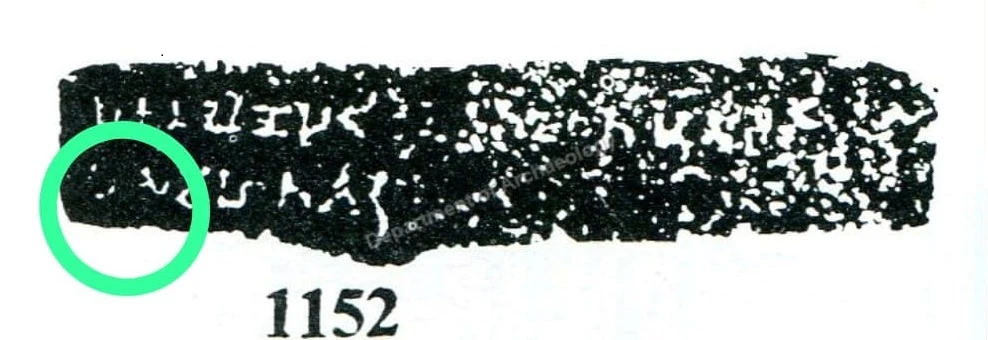
This further strengthens the possibility that the word on the ring may relate to a person called Pusa who belonged to the Sri Lankan Theravada Buddhist tradition.
In the mirror reading, the second letter from the right on the ring is “sa.” This particularly reminded me of Pali inscriptions associated with Sri Lanka.
Since the palaeographic character of the writing appears to belong approximately to the first century CE, I considered the possibility that the person may have belonged to the Sri Lankan Theravada Buddhist tradition.
The inscription appears to have been made during the period around the first century BCE or first century CE, when Sri Lankan Theravada Buddhism was beginning to spread in Thailand.
I therefore considered that the person associated with the ring may have been either a Buddhist from Sri Lanka or a local Thai Buddhist.
Although cremation became prominent among Buddhists after the death of the Buddha, burial continued to be practised to a limited extent—perhaps around 20 per cent—within Theravada, Hinayana and Mahayana Buddhist traditions.
I considered the burial at Phetchaburi to be an example of that smaller burial tradition.
My humble view is that the ring, the inscription and the person who wore it belonged to a Thai individual who followed a Sri Lankan-connected form of Theravada Buddhism.
The Influence of Tamili, Northern Tamili and Pallava-Grantha Scripts
The disputed fourth character is actually an independent letter that may be read as “sai” or “vai.”
The claim that it is a Northern Tamili, or Brahmi, conjunct letter is incorrect. Although the character contains a form resembling “sa,” it does not contain the distinctive Northern Tamili form required for the consonant “ka” in the conjunct “kṣa.”
Such conjunct structures can be clearly seen in Northern Tamili inscriptions such as the Lumbini–Rummindei pillar inscription in Nepal commissioned by Emperor Ashoka.
Therefore, the expression cannot be claimed as a northern-language name merely on the basis of the single letter “sa.”
The letter “sa” was also frequently used in Jain inscriptions of the Sangam period in Tamil Nadu. The presence of “sa” or “sha” in Tamil names such as Ramesh and Parameswaran does not make those people northerners.
Examining the Reading “Aḷarvairathan”
Let us now examine the proposed Tamili reading “Aḷarvairathan.”
The ancient connections between Tamil Nadu and eastern countries, including Thailand, are world-famous and well established.
A 2,000-year-old rubbing stone bearing the Tamili inscription “Perumpa(th)thankal” has already been documented in Thailand.
Since a software professional who read the Thai gold-ring inscription through the mirror method interpreted it as the Tamil name “Aḷarvairathan,” let us examine that reading carefully.
The first character in the inscription is not “a.” It is “pu.”
The second character is not “ḷa.” It is actually the Northern Tamili, or Brahmi, letter “sa.”
The third character, “ra,” has been read correctly.
The fourth character has a complex structure. It has been read as “vai.” However, because its lower curve does not join the adjacent vertical stroke, it should be read as “sai.”
The next character was read as a fifth “ra.” But no such letter exists at that position on the ring. An imaginary single vertical stroke appears to have been inserted into the reading.
The following letter “tha” has been read correctly. However, because a small horizontal stroke appears to be attached to the lower end of the character, it may also be read as “thu.”
The final letter has been read as “n.” But the last character has neither the form of Tamil “ṉa” nor “ṉ.”
Since it appears as a single vertical stroke, it should be read as “ra.” Even if a horizontal stroke is assumed to exist at its base, it does not have the distinctive Tamil form of “ṉa.”
If it were “ṉa” or “ṉ,” the upper curve would have to turn towards the right. In this character, however, it turns towards the left.
It may therefore have to be read as “nē.”
The mirror image cannot be altered and read according to our convenience.
Because a small horizontal stroke appears to turn towards the right at the lower end of the line, and because the letter itself is unclear, Sanskrit-oriented epigraphists read it either as “ṭa” or “ra,” in the same way that the place name is variously
pronounced as Chhattisgarh or Chhattisgar.
Possible Readings in Southern Tamili
If the inscription is treated as Southern Tamili, it may be read as:
“Pusaralēthara”
Because of the lack of clarity in the letters, it may also be read as:
“Pusaravaithara” or “Pusarasaithara”
These readings do not resemble a Tamil personal name.
In any event, the forced reading “Aḷarvairathan” is incorrect.
The confusion arises from the unclear engraving and from the manner in which the characters are interpreted.
One Tamil reading treats the Northern Tamili letter “sa” as “ḷa,” while the Northern Tamili reading interprets “sai,” “vai” or “ḷē” as “kṣē.”
If the opportunity arises to examine the ring clearly and directly, anyone familiar with the Tamili script should be able to read it more accurately.
Tamil Does Not Need “Forced Glories”
We are aware that the Tamil name “Sikaik Kotran,” said to have been found in an Egyptian pyramid, created worldwide interest.
Although it is a pure Tamil name, some Sanskrit-oriented scholars and some Tamil “researchers” claimed that the word “sikai” was Sanskrit. We rejected that claim and published a video explaining our position.
We must not repeat the same mistake made by them.
Tamil does not need “forced glories.” Such claims do not add honour to Tamil.
The Name May Belong to the Thai Person Who Wore the Ring
The signet ring was discovered in the Phetchaburi region of Thailand. The excavated site was a burial ground. This context must be taken into careful consideration.
There is no doubt that the letters on the ring belong to the Tamili or Brahmi script tradition.
But why have researchers failed—or refused—to consider that the name may belong to the Thai person who wore the ring?
Could DNA Testing Provide an Answer?
In today’s advanced scientific world, determining whether the person was Tamil or Thai may be relatively easy.
Thai archaeologists could conduct a DNA test. This could provide at least some degree of clarity.
It may help determine whether a Tamil person used a ring bearing writing associated with the Thai language; whether that person used a name written in the Tamili script containing the northern letter “sa”; or whether a Thai-speaking person had the inscription engraved in the Tamili or Northern Brahmi script that was in circulation there during that period.
Any of these possibilities may have occurred. Only the person who wore the ring would have known the full truth.
It Is Wrong to Claim It by Force Because of Our Love for Tamil
Pusara may have been the name of a place in Thailand. It may also have been the personal name of the person who wore the ring.
Chaithara may be a Thai-language word. The Thai language has close connections with Sanskrit, and because of the spread of Buddhism, a large proportion of Sanskrit-derived words entered Thai.
The word “Chaithara” is also used as a name in Thailand. It may refer to the month of Chithirai.
Therefore, “Pusarachaithara” may have been the name of a person belonging to that land. It may have been based on a star or a month. It may also mean Chaithara, a person from a place called Pusara.
The word “Pusara” is said to carry the meaning “burial pit” or “place of burial” in Thai and Malay.
Research must be based on the historical and cultural background of the land in which an object is found.
It is therefore wrong for Sanskrit-oriented researchers to claim it forcibly because of their attachment to Sanskrit, or for us to claim it forcibly because of our attachment to Tamil.
Similarly, when some Tamil Nadu researchers claimed that the name “Pandiyanadan” found in an Egyptian pyramid was derived from a northern word such as “Pandyatham” or “Bandham,” we did not surrender what we considered to be our rightful claim. We established that it was the Tamil name “Pandiyanadan.”
Therefore, just as it is important not to surrender our rights, it is equally important not to seize the rights and identities of others by force.
The Script Is Tamili or Northern Tamili—But the Name May Not Be Tamil
According to our study, the script used on the ring is undoubtedly either Tamili or Northern Tamili (Brahmi).
At the same time, the name engraved in that script appears to be the name of a son of the Thai soil.
Until the 13th century CE, the Thai language used script traditions derived from Tamili or Brahmi.
Only in 1292 CE did the Thai language develop its own separate script, drawing upon the Tamili, Brahmi and Pallava-Grantha script traditions.
Why Are Pure Tamil Names Necessary?
The message that this ring gives to Tamils is that we must give our children pure Tamil names.
Although the script on this ring belongs to the Tamili tradition, the presence of the Northern Brahmi letter “sa” makes it difficult to identify the inscription as distinctively Tamil or Tamili.
We should avoid giving our children Sanskrit-influenced names containing sounds and letters such as sa, sha, ha, das and push merely out of fascination for northern-language naming practices.
A person’s name and mother tongue are markers of an ethnic identity.
The tendency in Tamil Nadu to ridicule or mock pure Tamil names must come to an end.
In recent wedding and ear-piercing ceremony invitations, Tamil children are often referred to as “kutties” and given fashionable names ending in sounds such as “-ush” and “-push.” It is painful to see this trend.
A Warning for Future Archaeological Research
In future excavations, a person born into the Tamil community may be found bearing a name derived from Sanskrit, English or some other language.
At that time, we should not be left struggling to recover that person’s identity in the way the Thai ring-bearer—whether read as Pusarachaithara or Pusaravaithara—now appears to struggle to recover his identity from both Tamil and Northern Tamili researchers.
The Research Ethics Taught by “Every Place Is Our Town; Everyone Is Our Kin”
We must remember the Tamil names Sikaik Kotran and Pandiyanadan, said to have been inscribed in an Egyptian pyramid.
Our language and our names are our identities.
Just as we struggle when our identities are taken away, refraining from taking away the identities of others by forcing the name “Aḷarvairathan” upon them is also part of our identity.
Respecting others, honouring and protecting their identities, not appropriating them, and regarding them as our kin—these are all part of the distinctive Tamil identity.
This is what our ancestors taught not only to us, but to the entire world, through the words:
“Yathum Oore, Yavarum Kelir”
“Every place is our town; everyone is our kin.”
What's Your Reaction?
 Like
0
Like
0
 Dislike
0
Dislike
0
 Love
0
Love
0
 Funny
0
Funny
0
 Wow
0
Wow
0
 Sad
0
Sad
0
 Angry
0
Angry
0






Comments (0)