


A New World Converges in Delhi: BRICS Summit and India’s Global Rise
How did the New Delhi BRICS Summit strengthen India’s global position? From the US, Russia and China to the Global South, India is pursuing strategic autonomy and seeking its place as an independent power in an emerging multipolar world.
-Valarmeyyarivaan @ Vishwaa Viswanaath, Editor : Tamil Oodagam
Global politics is changing rapidly. New powers are emerging within the international order created after the Second World War, and India is increasingly seeking to establish a significant place for itself at the centre of this transformation.
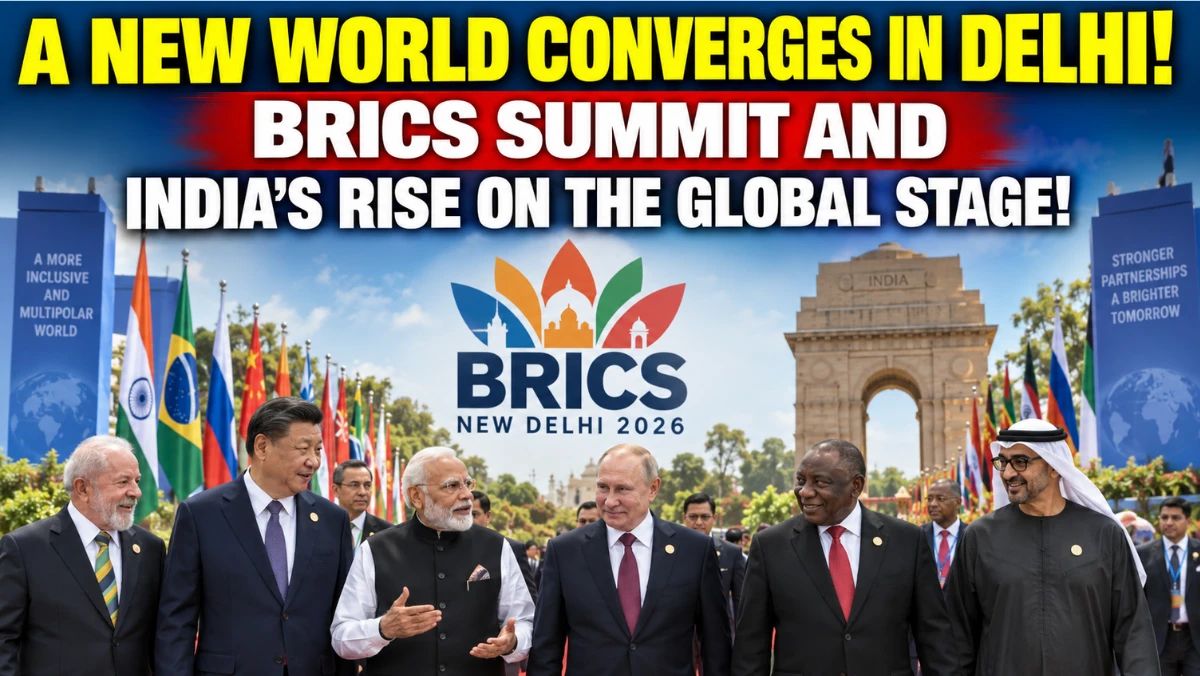
The BRICS Summit held in New Delhi in September 2026 emerged as an important event reflecting this changing global landscape.
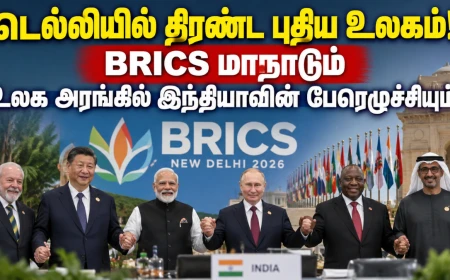
Indian Prime Minister Narendra Modi, Chinese President Xi Jinping and Russian President Vladimir Putin, along with leaders and representatives from Brazil, South Africa, Iran, the United Arab Emirates, Egypt, Ethiopia, Indonesia and other major emerging nations, came together in New Delhi.
Bringing countries with widely differing political positions together on a common platform for dialogue was not merely another diplomatic gathering. It demonstrated India’s growing diplomatic importance in global affairs.
India — Aligned With No Single Bloc
One of the greatest strengths of India’s foreign policy is its Strategic Autonomy.
India maintains a close relationship with the United States. Cooperation between the two countries has expanded across defence, technology, investment, the QUAD and the Indo-Pacific.
At the same time, India has not abandoned its decades-old relationship with Russia.
Despite border disputes and economic competition with China, India has also kept the doors of dialogue with Beijing open.
India continues to deepen its relationships with Europe, Japan, Australia, the Middle East, Africa and Latin America.
In other words, India can remain a close partner of the United States while continuing its long-standing friendship with Russia. It can compete with China while also sitting across the table from Beijing to discuss major global issues.
The New Delhi BRICS Summit once again demonstrated this distinctive feature of India’s foreign policy.
India’s Diplomatic Position After Pahalgam
On April 22, 2025, 26 people were killed in a terrorist attack targeting tourists in Pahalgam, Jammu and Kashmir.
India–Pakistan relations deteriorated sharply in the aftermath. Operation Sindoor and subsequent developments once again brought South Asia to the centre of international attention.
Against this backdrop, the support India received on the BRICS platform for its position against terrorism became particularly significant.
BRICS countries condemned the Pahalgam terrorist attack and reiterated that terrorism cannot be justified under any circumstances.
An important element here is that China is itself a major member of BRICS.
China–Pakistan relations remain strong. Nevertheless, the condemnation of the Pahalgam terrorist attack in a consensus document adopted by a multilateral grouping that includes China represents an important diplomatic gain for India.
China – Russia – India: An Emerging Political Equation
The presence of Modi, Xi Jinping and Putin on the same international platform in New Delhi attracted global attention.
Problems between India and China have not disappeared. Relations deteriorated sharply following the 2020 Galwan Valley clash, and geopolitical as well as economic competition between the two countries continues.
Yet international relations are ultimately shaped by national interests.
China has reasons to maintain economic and political dialogue with India. India, too, has an interest in managing border tensions while maintaining channels for trade and engagement on international issues.
For Russia, both India and China remain major global partners.
The India–China–Russia relationship therefore does not mean that the three countries have suddenly become members of a single political alliance.
Rather, BRICS has developed into a platform where countries can sit together and discuss common global concerns despite serious disagreements among themselves.
India’s position at the centre of such a platform further enhances its diplomatic significance.
India’s Long Journey Towards the UN Security Council
One of India’s long-standing global ambitions is to secure permanent membership of the United Nations Security Council.
At present, the five permanent members are the United States, Russia, China, France and the United Kingdom.
They also possess veto power.
But the world has changed dramatically since this international structure was created in 1945.
India today possesses one of the world’s largest populations and economies. It is a nuclear-armed state with significant space, technological and military capabilities.
India also plays an important role in major international groupings such as the G20, BRICS and QUAD.
Yet India still does not have a permanent seat on the UN Security Council.
India has therefore consistently argued that the Security Council must be reformed to reflect the realities of the contemporary world.
Support for reform of the United Nations and for a greater role for major emerging countries such as India and Brazil has again been reflected within the BRICS framework.
The fact that a BRICS consensus involving both China and Russia acknowledges aspirations for India to play a greater role in global affairs is politically significant.
This should not, however, be interpreted as an immediate guarantee that India will receive permanent membership with veto power.
Nevertheless, widening international recognition of India’s demand for a greater role in global governance represents an important development.
BRICS and the Emerging New World
BRICS is no longer limited to its original five members — Brazil, Russia, India, China and South Africa.
The grouping has expanded to include countries such as Egypt, Ethiopia, Iran, the United Arab Emirates and Indonesia.
BRICS is therefore increasingly becoming a major platform for amplifying the voices of Asia, Africa, Latin America and the Middle East in global affairs.
Its central political message need not be understood simply as an attempt to destroy or replace the West.
Rather, it reflects a demand that global decisions should not be shaped exclusively by Western powers and that developing countries should receive an appropriate role in global decision-making.
India has repeatedly argued that the countries of the Global South should not merely remain “rule-takers”, but should increasingly become “rule-shapers.”
That idea has become one of the important political themes surrounding the evolution of BRICS.
A Multipolar World and India’s New Place
The growth of BRICS does not mean that American global influence is about to disappear.
The United States remains one of the world’s foremost military, technological, financial and political powers. The US dollar also continues to occupy a central position in the international financial system.
But a broader change is becoming increasingly visible.
Global politics is gradually moving away from a world dominated by a single centre of power towards one in which several centres of power negotiate, compete and cooperate with one another.
The United States remains one major centre.
China is another.
Europe continues to possess considerable economic and political influence.
Russia is attempting to preserve its position as a major global power.
The Global South is gaining greater political weight.
Within this transformation, India does not want simply to stand behind China.
Nor does it want to stand permanently behind the United States.
India does not wish to become a subordinate partner of Russia either.
India seeks to emerge as an independent centre of global power in its own right.
India possesses several of the foundations required for such an ambition: a massive population, a rapidly growing economy, technological capabilities, nuclear power, a sophisticated space programme, a strategically important position in the Indian Ocean and historical relationships across the Global South.
Beyond these factors, India possesses another significant diplomatic advantage — its ability to engage simultaneously with competing centres of global power.
India has a place in Washington. It has long-standing ties in Moscow. It can sit across the table from Xi Jinping in New Delhi. It has important partners across the Middle East and continues to expand its engagement with Africa and the wider Global South.
This diplomatic flexibility is one of India’s most important geopolitical assets.
A New World Converged in Delhi
The New Delhi BRICS Summit must therefore be viewed within the context of this longer evolution of Indian foreign policy.
Following the Pahalgam terrorist attack, India secured support on the BRICS platform for its position against terrorism.
Dialogue with China has gained renewed importance.
India’s long-standing relationship with Russia continues.
At the same time, India has not abandoned its relations with the United States or the wider
Western world.
India’s demand for a greater role in institutions of global governance, including the United Nations, is also gaining greater prominence.
For these reasons, the New Delhi BRICS Summit cannot be viewed merely as another international conference.
It can also be seen as an expression of India’s evolving foreign-policy ambition — maintaining friendly relations with competing centres of global power while refusing to remain permanently under the shadow of any single great power and instead charting an independent course.
As the world moves towards an increasingly multipolar political order, India is attempting to transform itself from a country that merely asks for a place in an international system created by others into a country that participates in shaping the emerging global order itself.
The New Delhi BRICS Summit provided a powerful platform for displaying that transformation.
It was not merely BRICS countries that converged in New Delhi; in a broader sense, different centres of a changing world converged there.
And at the centre of that emerging multipolar world, India is increasingly attempting to build its own place — maintaining friendships across competing blocs, protecting its national interests and strategic autonomy, and seeking to establish itself as an independent centre of global power.
What's Your Reaction?
 Like
0
Like
0
 Dislike
0
Dislike
0
 Love
0
Love
0
 Funny
0
Funny
0
 Wow
0
Wow
0
 Sad
0
Sad
0
 Angry
0
Angry
0






Comments (0)